
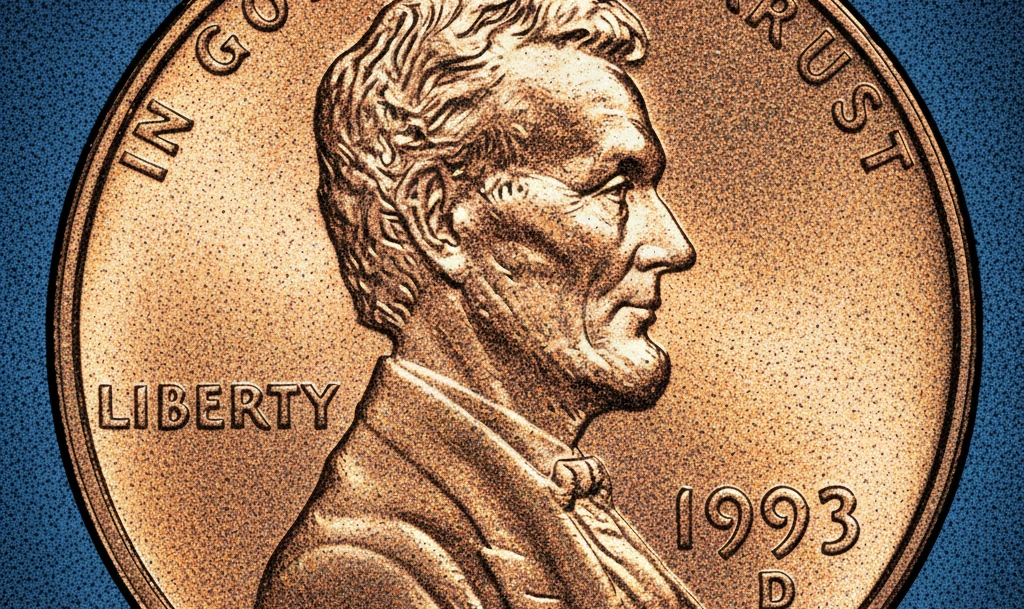
The 1993 cent bearing the "D" mint mark represents a Lincoln series specimen struck at the Denver Mint.
This issue concludes a specific stage in American minting history preceding significant reverse design changes occurring in subsequent decades.
Understanding the 1993 D penny value requires considering the physical parameters established by the United States Mint.
Characteristic | Value |
Denomination | 0.01 USD |
Composition | Copper-plated zinc (97.5% zinc, 2.5% copper) |
Weight | 2.5 grams |
Diameter | 19.05 mm |
Edge | Plain |
Obverse Designer | Victor David Brenner |
Reverse Designer | Frank Gasparro |
The planchet material introduced in 1982 remained unchanged for the 1993 issue.
Using a zinc core affects coin preservation by causing corrosion upon any breach of the thin copper layer.
Mintage Statistics and Production Volume
Total production volume at the Denver Mint in 1993 exceeded figures from many previous years.
High mintage determines the coin's availability in standard circulation, forming strict criteria for collectible specimens.
Mintage (Denver - D): 6,426,410,000 pieces.
Mintage (Philadelphia - P): 5,684,705,000 pieces.
In total, over 12 billion cents were produced in 1993.
Such quantity eliminates the scarcity of common coins, shifting the focus of researchers to specimens in ideal preservation.
Value Assessment Based on Grade (MS)
The market price of a 1993 D cent correlates directly with the Sheldon scale assessment performed by professional grading services like the coin value app, PCGS, NGC.
Coins having been in circulation retain only their face value.
Price appreciation begins with the MS65 (Mint State) condition.
Grade (MS) | Estimated Market Price (USD) | 5-Year Average Growth (%) |
MS63 | $0.10 - $0.25 | 0% |
MS65 | $1.00 - $3.00 | +5% |
MS67 | $15.00 - $25.00 | +12% |
MS68 | $75.00 - $150.00 | +18% |
MS69 | $500.00+ | +25% |
Specimens in MS69 condition occur extremely rarely due to mass production features and bag transportation.
Surface damage appearing during coin contact during the minting process lowers the final grade.
Auction Records and Maximum Sales
Record prices are established at public auctions held by Heritage Auctions and Stack’s Bowers.
Analysis shows that over the last 10 years, the value of top grades demonstrates a stable upward trend.
PCGS MS69 Red: Sold in 2023 for $720.
PCGS MS68 Red: Realized in 2018 for $144.
NGC MS68 Red: Sold in 2021 for $110.
The "Red" (RD) classification indicates the retention of over 95% of original copper luster.
A coin transitioning into the "Red-Brown" (RB) or "Brown" (BN) category loses 60–80% of its value, even with great detail.
Varieties and Mint Errors
Nuismatists pay special attention to deviations from the standard technological process.
Several types of production defects were recorded at the Denver Mint in 1993.
Off-Center Strike
A planchet shift relative to the die results in a partial loss of the image.
Value depends on the percentage of displacement and the presence of the date on the visible part.
10–20% displacement: $5 – $15.
50% displacement with full date: $50 – $100.
Doubled Die
Despite the absence of major confirmed "Doubled Die Obverse" (DDO) for Denver in 1993, micro-varieties exist.
Researchers find slight thickening of letters in the word "LIBERTY" and the date.
Such specimens require 10x magnification for identification.
Die Cracks
Equipment wear causes raised lines to appear on the coin surface.
The "BIE" variety characterized by a vertical line between the letters "B" and "E" in "LIBERTY" is the most well-known.
Influence of the Denver Mint on Value
The Denver Mint traditionally uses dies longer than Philadelphia.
This leads to specific textures appearing on the coin field, called "flow lines."
The presence of clear flow lines while maintaining sharp details is valued higher by experts than an absolutely smooth field.
Investment Potential and Market Trends
Analyzing data for the 2010–2025 period highlights several patterns:
Annual MS69 population reduction: Zinc oxidation causes the number of top-grade coins to decrease by 1–2% annually.
Stability of lower grades: Coins below MS66 show no investment growth, remaining within inflation expectations.
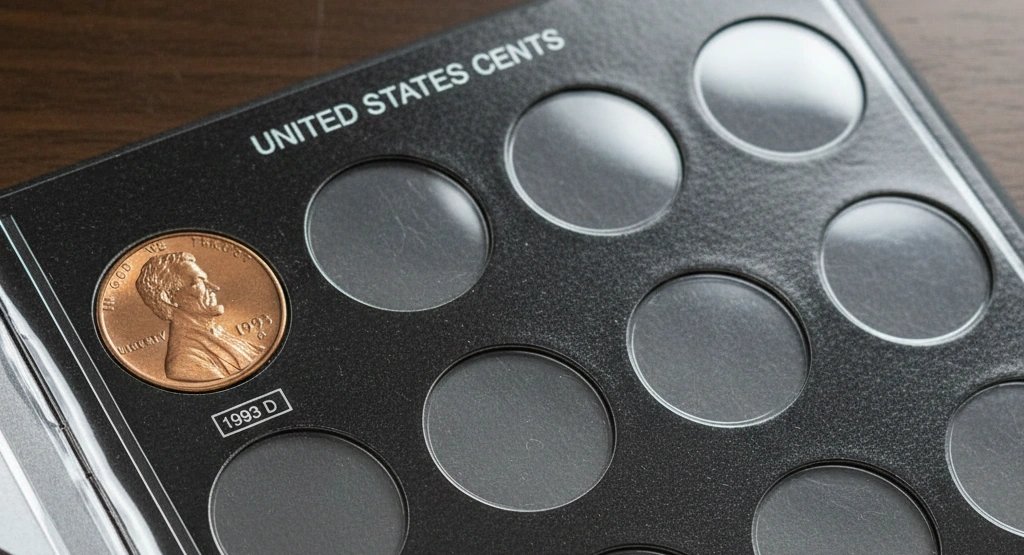
Increased demand for certified sets: "Year Sets" improve the liquidity of individual 1993 D specimens.
Comparing the two main issues of the year reveals technical differences in strike quality.
Parameter | 1993 D (Denver) | 1993 P (Philadelphia) |
Die Quality | Frequent use of worn pairs | More frequent equipment replacement |
Surface Preservation | Tendency for micro-scratches | More pronounced "bag marks" |
Record Price | ~$720 | ~$2,500 (higher due to MS69 rarity) |
Although the Denver mintage is higher, finding a specimen without copper plating defects is more difficult due to storage conditions in Western warehouses.
Methodology for Determining Authenticity and Condition
Following a set inspection algorithm is necessary for accurate 1993 D value identification with the free coin identifier app.
Weight Check: The weight must be exactly 2.5 g with a margin of error not exceeding 0.1 g.
Mint Mark Study: The letter "D" must be located directly below the date without signs of manual alteration.
Luster Analysis: Original mint luster has a radial structure emanating from the center to the edges.
Plating Bubbles Search: Bubbles appearing under the copper layer lower the grade, being a sign of production defect.
Conclusion
The 1993 D cent remains an accessible object for studying late 20th-century mass minting.
Its primary numismatic value is concentrated in an extremely narrow segment of ideal preservation and specific production errors.
Statistical data confirm the absence of significant price fluctuations for 99% of the existing mintage, focusing interest exclusively on the top 0.1% of the population.